
A Complete Guide to Electronic Throttle Valve: Common Faults and Selection Tips
22.05.2026
In modern automotive engine intake systems, the electronic throttle valve is known as the “throat” of the engine. It directly determines the vehicle's power response, fuel economy, and emission performance.
For car owners and mechanics who pursue original factory quality, a deep understanding of the core structure and common causes of failure of throttle valves is key to ensuring efficient engine operation.
What is electronic throttle valve?
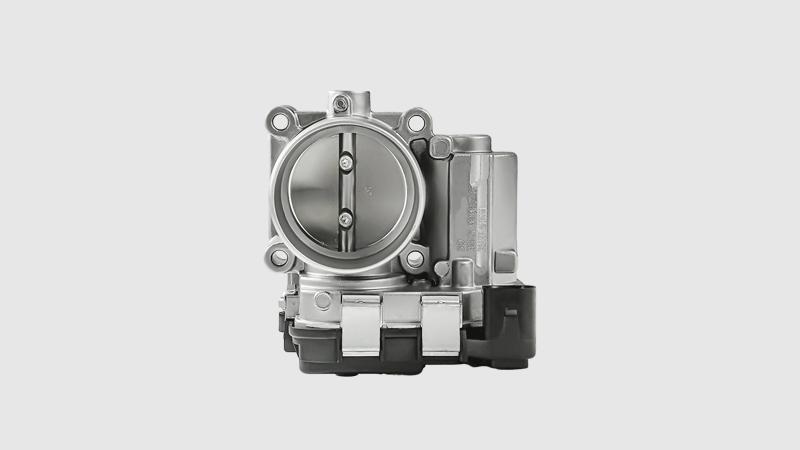
The electronic control throttle valve (commonly referred to as the "throttle valve"), is a core control component of an automobile engine's intake system. If we compare the engine to the heart of a vehicle,the throttle valve can be regarded as the engine's "intake valve switch" and "power throat".
Unlike traditional mechanical cable throttles, modern electronic throttle valves achieve highly intelligent automatic adjustment by receiving electronic signals from the engine control unit (ECU).
Core parts of an electronic throttle valve:
A high-quality electronic throttle valve is mainly composed of the following precision components:
Throttle body: A high-strength shell that houses all internal components.
Drive motor: The core power source that precisely drives the opening and closing of the valve plate.
Position sensor: High-performance Hall effect sensors are typically used to monitor the valve plate angle and provide feedback to the ECU in real time.
Throttle plate (throttle butterfly plate): A rotating valve plate inside the air passage that controls airflow by adjusting its rotation angle.
Core function of electronic throttle valve
The core function of the electronic throttle valve is to precisely control the engine's air intake. By finely adjusting the air-fuel mixture ratio, it achieves an optimal balance between power output, fuel consumption, and exhaust emissions under various operating conditions.
Common fault analysis: How to Identify and respond to faults?
As the mileage increases, an electronic throttle valve and related components may experience the following faults:
1.Carbon buildup in the throttle body and a sticking throttle plate
Symptoms: Rough idling, sluggish acceleration, hard startup, and even occasional stalling.
Cause: Oil vapors from the crankcase ventilation system mix with impurities in the air, forming sludge-like carbon deposits around the throttle plate.
Solution: Regularly clean the throttle valve (preferably every 20,000-30,000 km, or make adjustment based on fuel quality).
2.Hall effect position sensor fault
Symptoms: The EPC fault indicator is on, the throttle opening data is abnormal, and the engine enters limp mode.
Cause: The sensor experiences signal drift or complete failure after prolonged exposure to high temperatures.
Solution: Check if the sensor connector is loose. Replace the throttle valve assembly if necessary.
3.Wear or burnout of the drive motor
Symptoms: There is no response after the accelerator pedal is pressed, and the throttle valve plate remains completely inactive.
Cause: Worn motor brushes, short-circuited windings, or abnormal drive current from the ECU.
Solution: Replace the throttle valve assembly in time to avoid secondary damage caused by continued driving.
4.Sticking idle control valve on the EA211 1.0L three-cylinder engine (a common failure)
Key focus: Throttle valves used for Volkswagen EA211 series 1.0L three-cylinder naturally aspirated / turbocharged engines
Symptoms: Difficult cold startup, rough idle (shaking), and frequent stalling.
Special cause: On VAG’s classic EA211 1.0L three-cylinder naturally aspirated engine, due to the inherent vibration characteristics of three-cylinder engines and the design of the intake manifold, the throttle body is highly prone to recurrent sticking.
Solution: It is recommended to regularly inspect and replace the throttle valve assembly using high-quality OEM parts.
How to select an electronic throttle valve?
In the demanding automotive aftermarket, choosing an electronic throttle valve with original equipment quality is the key to ensuring efficient engine operation.
Borsehung consistently adheres to the original German quality standards throughout all processes. We maintain not only full-process quality traceability and rigorous factory inspections, but also efficient global logistics and modern packaging systems to support smooth shipment. This enables us to provide you with integrated, high-standard component solutions, freeing you entirely from any after-sales concerns.